
AI Tools for Marketing Won't Save You. Strategy Will.
What I'm Learning About AI Tools for Marketing (From Someone Who Uses Them Every Day)
I want to be straight with you: AI scared the hell out of me at first.
In fact, I spent a year and a half working for a public company focused on AI and machine learning specifically to understand what these changes would mean. I wanted to be inside it, not reading about it from the outside.
Now I've built AI tools into virtually every part of my marketing workflow, for myself and for clients, and what I've learned has shifted how I think about execution completely. Not strategy. Execution.
The Shift I Didn't Expect
I expected AI to save me time. It does. What I didn't expect was how much mental energy it would free up.
When you're not spending three hours writing a blog post from scratch, you're not just saving three hours. You're saving the cognitive drain that comes with staring at a blank page. That energy goes back into thinking about positioning, about what a client actually needs, and about the strategic calls that AI genuinely cannot make.
That's the real win. Not speed. Clarity.
The AI Tools for Marketing I Use and What They Actually Do
I'm not going to list 47 tools and tell you they all changed my life. Here's what I actually use today, and why.
ChatGPT (OpenAI)
This is the workhorse. I use it for first drafts of blog posts, email copy, social posts, positioning frameworks, and proposal language. The key word is first drafts. Everything gets edited. Everything gets run through my own judgment before it goes anywhere near a client or a publish button.
What I've learned: ChatGPT is only as good as the brief you give it. If you put vague in, you get vague out. The quality of the prompt is the quality of the output. That's a strategy skill, not a tool skill.
Perplexity
I use Perplexity for research. When I need to understand a client's industry quickly, find recent data, or check what competitors are saying, Perplexity gets me there faster than a traditional search and gives me cited sources I can verify. It's replaced a significant chunk of the time I used to spend on preliminary research.
GPT-Image-2 and Gemini (for image generation)
I generate a lot of marketing images using AI now. Brand visuals, social graphics, LinkedIn images, campaign imagery. What used to require a designer briefing or a stock photo search now takes minutes.
The caveat: Google’s Gemini (and all tools) AI image generation still needs a sharp creative brief. "Make something professional" produces generic results. "A woman in an eggplant shirt on a white studio background, seated on a block, leaning slightly forward, soft shadow below" produces something usable.
Sora (video generation)
Short-form video for social content. I use it to create concept videos and marketing reels without a production crew. Sora is not perfect and it still needs strategic direction, but for a service business that wants consistent video content without a $5,000 shoot, it's genuinely useful.
Notion (organization and strategy documentation)
I use Notion to keep client strategies, research, and content plans organized in one place. It's not a marketing execution tool on its own, but it's where the thinking lives. Every client has a space where briefs, brand guidelines, and performance notes are stored so nothing gets lost between sessions. Honestly, this is what keeps me from going a little ‘cray cray’. I used to spend hours trying to find stuff and now I don’t. But the learning curve on Notion is steep.
AI-assisted scheduling and publishing
I use an AI marketing platform that connects all channels: LinkedIn, Instagram, and Facebook, and handles scheduling, calendar management, and performance tracking in one place. The AI layer drafts content, suggests timing, and surfaces what's working. I approve, adjust, and deploy.
This is where the one-hour-a-month model I offer clients actually comes from. When the right systems are in place, the execution runs. My job becomes directing it, not doing it.
What AI Cannot Do (And This Part Matters)
AI tools for marketing are execution tools. They are not strategy tools.
They cannot tell you:
- Who your best client actually is
- Why someone chooses you over a competitor
- What your positioning should be
- Which channel is worth your time right now
- What message is going to land with a specific audience at a specific moment
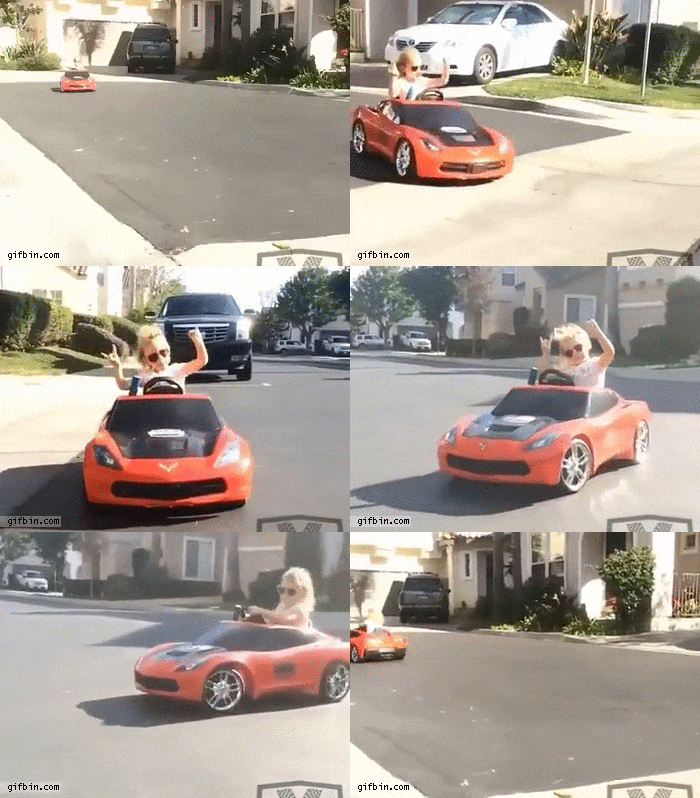
Strategy decisions take someone directing not drifting.
These decisions require judgment, context, and experience. AI executes on those decisions once you've made them. If you haven't made them, AI just executes faster on the wrong thing. I see marketers (especially product marketers) pumping out documents with AI but they are amplifying the wrong stuff.
Who do you want driving decisions in your business?
This is the mistake I see service business owners make most often. They get a tool, they start producing content, and none of it converts because the strategy underneath was never sorted out. Volume is not a marketing strategy.
What I Tell Clients About AI Tools for Marketing
Start with the strategy. Get clear on your positioning, your audience, and your offer. Know what you want your marketing to do before you ask an AI to help you do it.
Once that's in place, AI makes the execution faster, cheaper, and more consistent than it's ever been. A service business that used to need a content team, a designer, a video editor, and a copywriter can now get consistent, quality marketing output with a fraction of those resources — as long as there's a human strategist setting the direction.
That's what I do for clients. I set the strategy. I configure the tools. I run the execution. They spend about an hour a month approving what's next.
The AI doesn't replace the thinking. It just means the thinking goes further.The Bottom Line
AI tools for marketing are the best thing that has happened to execution in a long time. The businesses that win with them are the ones who treat them as execution tools, not strategy substitutes.
Now I love the tools and how they help me execute faster. If you want consistent marketing that actually runs without you doing the work, that's exactly what I build. Book a free Advisory Session and let's talk about what that looks like for your business.